Tuesday, November 9, 2010

Crystallized Gold


I came across a beautiful parcel of crystallized Gold from Venezuela.
It was really difficult to make a choice with so many beautiful crystals.
They come from Santa Elena de Uairén,  a small city (29,795 inhabitants in 2006) in the state of Bolivar,  near the border with Brazil and Guyana.
Gold comes in various shapes and forms, and there are several classifications of  Gold forms, from dendritic, (gold that grows in tree-like branches), to leaf ( Gold that grows in thin to extremely thin sheets) , to wire (Gold that grows in the form of thin wires or thicker “ropes"), crystallized Gold, ( Gold with geometric crystals visible to the naked eye.) These last ones can be very rare, and are highly valued by collectors. Among other shapes, they can be octahedron, trigon, cubic, they can be hoppered, (gold that forms step like structures otherwise known as chevrons.)
The photo above has all the pieces I bough and most of them are available at  LucianaBarbosa.com .
In the begining these gold pieces were labeled as "Palladiun-rich" there was a lot of controversy, on how much Palladium it would need to have to bear that label. I know a lot of them do not have Palladium at all so I think the safe bet is not to call them Palladium-rich.
John Rakovan, from the Dep. of Geology, Miami University, Oxford, Ohio. did extensive reseach on those pieces, part of his reasearch was published on Rocks and Minerals, and you can see the article here.
The article is called " Characterization of Gold Crystallinity by Diffraction Methods" and it is very thorough.
If you are curious about the formation of these pieces, this is a great resource.


Sunday, October 17, 2010

It's beginning to look a lot like FALL


The weather is starting to cool down. It has been drizzling since last night, which I love, specially because I don't have to get out of the house today. I woke up thinking I wanted something simple yet very hearty. Nothing better than a nice bowl of hot soup on days like this.
So I headed to the kitchen in my "it's beginning to look a lot like fall" mode and here it is, a light version of what could be a heavy soup, but with lots of flavor!

Corn and Crab Chowder
3 tablespoons olive oil
1/2 cup finely chopped onions
3 cups uncooked sweet corn from the cob
4 cloves of garlic (minced or pressed)
1/2 cup of finely chopped celery
1 cup crab stock or fish stock
3 bay leaves
Salt and pepper to taste
4 cups of milk  (if you want it richer you can substitute one or two cups of milk for cream)
1 teaspoons crab boil
3 tablespoons corn starch (dissolved in cold water)
1 and 1/2 cups lump crab meat, picked over for shells and cartilage
1 teaspoon Worcestershire sauce
Parsley for garnish
1 teaspoon of paprika
1/2 teaspoon of cayenne pepper
1/2 teaspoon each of thyme and oregano (dried)

In a large saucepan heat the olive oil. When the oil is smoking hot, add the onions, corn, garlic, celery and saute for 1 minute. Season with paprika, cayenne, oregano and thyme. Add the stock, and bay leaves. Season with salt and pepper. Bring the mixture to a boil. Whisk in the milk, cream if you are using it, and crab boil. Bring back to a boil, reduce to a simmer. Simmer for 5-7 minutes. Whisk in the corn starch, 1 tablespoon at a time, checking for desired thickness. Reduce the heat to low and continue to cook,  (if you want thicker, you can add a little more corn starch.)  Stir in the crab meat and Worcestershire and simmer for 6-8 minutes. Re-season if needed. Ladle into the bowls and garnish with parsley.


Tuesday, September 21, 2010

Green Hydroxylherderite

Twenty years ago, my father came across a lot with 2 rough pieces of "Green Apatite". It was previously sold as Beryl, and the person who had bought it saw it was too soft when he was trying to cut it. The lot was promptly returned and the second known possibility was Apatite. My father always liked the unusual, collector's gems and they looked pretty darn good as Apatites. At that time, people cared mostly about Beryls, Topazes and Tourmalines.
The pieces came from an old man that had it stashed for a while. He said they came from Ouro Verde de Minas Gerais, a small municipality located in the northeast of Minas Gerais, neighboring Teofilo Otoni. There are not a lot of minerals that come specifically from Ouro Verde, but it is right in the middle of that pegmatite rich area in the Doce Valley. I love the fact the Ouro Verde means green gold in Portuguese.
The stones were analyzed first at the Federal University of Minas Gerais by X-ray and the result: Hydroxylherderite. So much better than Apatite. It was truly green gold! One of the pieces was quite large and we were able to cut a few large stones with around 50 to 90 carats. Smaller pieces were later sent to GIA for confirmation. Everyone was so amazed by the color, size and transparency of the pieces. One piece was featured on Gems and Gemology at the time. My father kept going back to the dealer's house to see if he could get more and one day, finally, he sold him one last piece. It had 5 kilos. Huge! Not all facetable, but from that piece, he cut a 160 carat pear shape:

It was amazing. The largest in the world probably and undoubtly the finest. From the same rough, many smaller pieces were cut. My father went back for years to see if he could get another piece, until the old man was no longer around. That was it. We sold some pieces to museums around the world, collectors, big and small. And we still treasure a few in our inventory and ocasionally put one up for sale. And the big one? It is in the Smithsonian since 2008.  (click the link and you will see it on their website)

Tuesday, August 31, 2010

My Killer Gazpacho

We lived in Spain for a year when I was 10. My father got his gemology degree at the Instituto Gemologico Español. We fell in love with spanish food, (yes, I remember). My mother bought a gigantic Spanish recipe book and started trying recipes. My favorite was the gazpacho.
Gazpacho is a chilled soup with Spanish origins. It is widely consumed through Spain and Portugal.
It is the perfect summer dish for its freshness. It is like a salad made into a soup. There are many reasons to love gazpacho: It's easy to make, you can make it ahead, you don't need a stove, and the presentation can be beautiful.
I know it's the end of summer and I should have posted this way sooner but I hear it's still pretty hot everywhere and I just made this gazpacho this weekend for a dinner party and it was a success.
Here is what you need:

10 ripe tomatoes
1 small garlic clove ( I put half depending on the size)
1 slice of a nice crusty bread (sourdough works) in pieces.
red wine vinegar to taste ( I use 1 to 2 tablespoons)
1/2 cup good extra virgin olive oil
salt to taste

Start blending the tomatoes, in batches. when its a puree, add the olive oil, vinegar and garlic and salt. Blend some more. Add the bread pieces and taste for salt and vinegar. it should have a good balance of salt and tartness. You can add half cup of water or so to make it a little smoother.
Strain into a pitcher, check if it needs more water and chill for a couple hours.

Garnish:
Cucumber diced in small cubes (1/4 inch)
red pepper diced in small cubes
slices of bread diced in small cubes (1/2 inch)
chives

There are many ways to present gazpacho. The traditional way is to serve in in a soup bowl with the garnishes on separate little bowls so people can add as much or as little of each ingredient as they want.
Or you can bring the little bowls already assembled. For parties, you can serve them in shot glasses sprinkled with smaller garnish and a parsley leaf and a little olive oil drizzle. You can also get creative and add crab meat or a grilled shrimp skewer, and make it a main dish.

Thursday, August 19, 2010

Ouro Preto and Imperial Topaz

Ouro Preto, (Black Gold) founded at the end of the 17th century,  was the epicenter of Brazil's gold rush in the 18th century under Portuguese rule.
The city contains well preserved Portuguese colonial architecture, with few signs of modern urban life. Modern construction must adhere to historical standards maintained by the city, to keep its UNESCO heritage status.
From Belo Horizonte it takes one and a half hour to reach it, through a winding but pleasant road.
Ouro Preto was the capital of Minas Gerais from 1822 until 1897, when the needs of the government outgrew this town in the valley. The state government was moved to the new, planned city of Belo Horizonte.
There are several Imperial Topaz Mines in the area, apart from many nameless small open pits. The most important mines are Mina do Vermelhão, in Saramenha and the Capão Mine. This last one is the largest mine for Imperial Topaz in the world. It is an open cast mine, where weathered topaz-quartz-calcite veins are mined. The gravel is transported by a dredge bucket to the hydraulic washing station. The clay is removed with huge water cannons and the material is transported to a sorting a belt, where the crystals are picked out by workers. They process tons of clay to get a few dozen topaz crystals per day (2 cubic meters of rough for 1ct of gem).    
I am not a miner and I have only been inside a handful of mines in my life. So I can't say how amazing it is to dig your own stone, but I can say how great it is to be able to buy from the source. In Ouro Preto, when you visit a mine like Capão, you go as a tourist, you watch, take pictures, have a lecture and get a peak at beautiful overpriced crystals. It is quite interesting but from a business point of view, it's prohibitive. So we rely on the good old small mines. It is quite gratifying to get lucky and see a nice little crystal being found in front of your eyes and then try to bargain a fair price for it. (The prices are crazy in every little corner of the world.)

This trip, I was really lucky. I was able to get Topaz on matrix, Topaz inside gemmy Quartz , Gem grade Topaz, that is being cut as I type and some beautiful  Purple Topaz!

Tuesday, August 3, 2010

A Special Alexandrite

Sometimes we get lucky to be at the right place at the right time. This is one of the most beautiful pieces
of Alexandrite I've ever seen. You can see from the video how much it glows when back lit. The color is much better in person. It is a much brighter purple-pink color.
It is one of the mineral highlights of this trip to Brazil. (along with the large Euclase crystal)

Enjoy!!


Monday, August 2, 2010

Quartz, Quartz and more Quartz

Curvelo is a small town two hours drive from Belo Horizonte. If there's no road construction that is. Our way back took 4 hours due to repairs on a bridge. It is a large Quartz producing area and has a few adjacent villages, like Corinto, where Quartz is also mined and polished. This area is one of my favorite places to go. It is where my father finds the treasures inside Quartz (Inclusions). It is not as easy as it sounds though. Sometimes we have to go through thousands of kilos of material to find a few pieces of interesting material. Once we find something interesting, we have it cut or polished to make the inclusions very visible and aesthetic. The cutting process is carefully followed by my father to insure it is cut properly. The picture below shows one of the places where our pieces are polished. Note the last photo where my father stares attentively as the cutter saws one of the pieces. We have just cut really great Quartz pieces with Tourmalines inside and some with Pyrite. I am bringing lots of new inclusions along with some minerals that rank really high on the cuteness scale.


Now if you love spheres, this is your place. The best sphere makers are in Curvelo. When we find large enough pieces of unusual rough material, we have them cut there. We are making some Garnet ones at present that will be ready for Denver.
Here is a picture of some big.. really big spheres we saw for sale:

Can you imagine the shipping cost? I am glad there were no inclusions!


Sunday, July 11, 2010

Euclase and Monkeys

The trip to Brazil is going well. I have been finding really good specimens and gems. I have a gorgeous Euclase crystal and some faceted stones of great size.  An Alexandrite on matrix that although not complete, is huge and lights up when backlit. I will photograph that very soon. Also some great inclusions in Quartz and some really great Tourmalines from Escondido Mine. I am trying to make a little studio setting but I still need the lighting. This coming week we are going to Bahia. We went to my parents house outside Belo Horizonte and there are so many monkeys around. They usually come in the morning and make a lot of noise. Once you bring a banana out, they crowd the trees around you. They are scared in the begining but end up going for it. The name in english is Black-tufted Marmoset (Callithrix penicillata) Here we call them Mico Estrela. Estrela means star. They have a little white spot in their foreheads that sometimes look like a little star.
So here is a video of them:

I had to crop part of it to be able to upload to flickr

Friday, June 18, 2010

Colorful Minerals


I remember being a little girl and seeing my father's collection of cut stones inside little plexiglass boxes, all carefully arranged in black boxes with lids, stacked inside the safe. It was kind of magical, like a treasure hidden in the safe. I would see a row of colorful stones and ask: What's this one? He would reply: Tourmaline. And this? Tourmaline. This? Tourmaline. It would go on for rows and rows. It was my favorite. How can they come in so many different colors?
There are many factors that influence color in minerals. My favorite "factor" is impurity.
Impurities are elements (e.g., Ti, V, Cr, Mn, Fe, Co, Ni, Cu...) that are not present in the pure compound. They occur in low concentration in the stone.
Take Amethyst, Citrine, Rose Quartz, Smoky Quartz. They all have the same SiO2  Quartz formula. What causes the different colors is the presence of chemical impurities.
Beryl is another example. With different impurities, we get different colors:
Morganite and Red Beryl contain Manganese. Aquamarine and Heliodor are colored by Iron. Emerald is colored by Cromium. The hues depend on the amounts of each element.
One famous example of color by impurity is Paraiba Tourmaline. The bright neon color is cause by Copper.
Another interesting fact is that Chromium makes Emerald green, but it also makes Ruby red.

Here are some examples of color by impurity:
Top row: Spodumenes: Hiddenite, Kunzite and Colorless
Middle row: Tourmalines: Rubellite, Yellow and Green
Bottom row: Beryls: Aquamarine, Morganite and Heliodor

I still marvel when I see a Tourmaline in a color that I haven't seen before!

Thursday, June 10, 2010

The 3 hour Gnocchi

Gnocchi is one of my favorite dishes. I test restaurants by ordering gnocchi. If they have a good one, the rest is probably very good too. Most places use too much flour so it gets harder then it should (in my opinion). I like it soft, creamy, with a lot of potato taste.
After getting disappointed with my last gnocchi order, I decided I could do better. I even had the sauce in mind. I just had to do the dumplings.. "Just".. as if it was that simple.
I got beautiful yukon gold potatoes. Big, with not a lot of bumps and smooth skin. I usually bake them in the oven or the microwave. I Find that if you boil them, the water makes it too soggy for gnocchi, calling for more flour.  Since the potatoes I got were huge, it took half an hour for them to bake.  So, let's start with the recipe:
3 pounds of yukon gold (russet works too)
1 and a half cup of flour
1 large egg
1 teaspoon of kosher salt
1/2 cup of olive oil or any mild vegetable oil.
A big pot with boiling water with 1 tbs of salt.

After the potatoes are baked, press them through a potato ricer. (Yes, it is one more gadget to buy but, you can use them for fantastic mashed potatoes too)
Make a little potato "volcano" on the clean surface of your counter.
Sprinkle the whole volcano with the flour and the salt and break the egg in the center. 
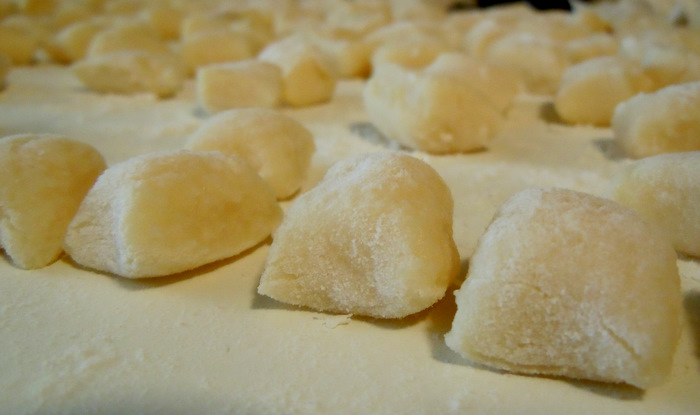
Start mixing everything with a fork, and then begin kneading with your hands until it come together.  If it is still sticky, add more flour and keep kneading until it's dry to the touch. Divide the dough into 6 balls. Roll the balls into ropes of  3/4 inch diameter, and cut them in little pillows of 1 inch.
Some people like to roll them with a fork to create the typical ridges. I think they look good as little pillows, besides, I didn't want this to become the 4 hour gnocchi.

Drop the gnocchi in batches in the boiling water. At first, they will sink and when they are ready, they will float. Transfer the cooked gnocchi to a large pyrex and as you go, drizzle a little olive oil, so they don't stick. Toss them a little to make sure they are all coated. You can keep them covered in the fridge for 2 days. I made two pyrex, one I kept in the fridge, the other I used right away with the following sauce:
Tomatos, olives and smoked mozzarella sauce:
1 pound of ripe plum tomatoes chopped in little cubes
6 tablespoons extra virgin olive oil.
2 cloves of garlic, sliced very thinly.
1/2 cup of sliced green olives
3 ounces of smoked Mozzarella in small cubes
1 cup of fresh basil, coarsely chopped.
sal and pepper to taste.
Saute the garlic in the olive oil until light golden. Add the tomatoes and cook for 2 to 3 minutes. Add the olives, stir well, seanson with salt and pepper and turn the heat off. Add the cooked gnocchi to the pan, the mozzarella and the basil leaves.
Stir gently and serve immediately.


Note 1:
It is very easy to make this recipe. The only problem is that it's time consuming and can be messy. So messy that afterwards I thought it would take forever for me to want to venture in gnocchi-land again. I must confess, it was so good, I am already flirting with the idea of doing it again soon. Who knows? maybe with the experience I got, it will only take me 2 hours.
Note 2:
The unused gnocchi that was kept in the fridge can be revived by a quick boil again, or pan sauted with olive oil and then served with he same sauce or a different one. hmm I am having new ideas...