Saturday, July 21, 2012

Roasted Okra with Spicy Tomato Sauce


I wish I had taken more photos of this dish. The result was really surprising.
I love okra. It is a common ingredient in Brazilian cuisine.
Okra is rich in dietary fiber, vitamin K, vitamin A, folates and vitamine C.
It is low in calories and high in flavor.
It is delicious in stews but this recipe has it roasted, which kept its shape and gave it a sharper flavor.

Ingredients:

olive oil
1 small onion chopped
1/4 tea spoon piment d'espelette
1/4 tea spoon smoked paprika
1/2 cup chopped cilantro
1/3 cup chopped parsley
2 large tomatoes
1 teaspoon sugar
1 cup water
1 pound of whole okra (trim the stem carefully not to expose the seeds)
1/4 tea spoon lemon zest
1/2 cup of Kalamata olives
1 tbsp lemon juice
2 tbsp chopped mint
3 tbsp toasted pine nuts


Preheat the oven to 400˚F
coat the okra with olive oil and sprinkle with salt. Roast for 20 minutes or so, turning them once.
They will be very slightly browned.

Heat 2 tbsp of olive oil, saute the onion until they are soft, add the parsley, cilantro, piment and smoked paprika, give it a good stir and simmer for 3 minutes. Add the chopped tomatoes, water and sugar and simmer with a lid for about 15 minutes. Removed the lid. Add salt to taste. (easy on the salt because of the olives)
Simmer for another 5 minutes, or until the sauce is thickened a bit.
Add the olives, the lemon juice and the lemon zest.
Add the roasted okra, the chopped mint and carefully stir to coat them well.
Serve with couscous and finish with the toasted pine nuts.


Wednesday, July 11, 2012

So Beet It, Just Beet It!

Last Sunday I needed to get groceries for the week and wasn't able to get to the farmers market so I ended up going to good old Whole Foods. One of the first things that caught my eye there was this gigantic beet.
I though, wow! Lucky that nobody got it before me!
At the register, I realized it wasn't luck, it was by the pound price. So I left with my almost 10 dollars beet.
Of course the fun I had with it was priceless. :) Here are some photos comparing it with other things.
Small watermelon, big beet:

cooked beet and an apple:
 Sliced beet and an egg:


First I cooked it in the pressure cooker for 20 minutes. When it cooled down, I sliced it.
The bigger slices took almost the whole space of a dinner plate.
So I used one big slice for a salad with goat cheese and pine nuts.

Part of the beet was used to make a gazpacho that I then served with goat cheese and fig crostini.
The gazpacho was crazy good, perfect for summer and so easy to make.
Here is the recipe:

1 1/2 lb of cooked beets in cubes.
1 tomato, chopped.
1 slice of bread without the crust.
1/3 cup of pine nuts.
1tbsp dijon mustard
2 tbsp balsamic vinegar.
1/2 cup olive oil.
1/2 cup of water or more if you think it's too thick.
salt and pepper to taste

Pulse everything in the blender until you get a smooth texture, season with salt and pepper and chill.
Serve with crumbled goat cheese or serve with crostini and a salad.

Believe it or not I still have half of the beet chopped in the fridge!

Monday, July 9, 2012

Chilean Sea Bass "En Papillote"


Chilean sea bass is one of my favorite white fish. Apart from being sustainable, it is mild with a moist, flaky texture. 
Cooking "en papillote" is a very easy and fun way to prepare it.  You seal the ingredients in little parcels of parchment paper or foil, pop it in the oven and voilà! Dinner is ready! 


2 pieces of Chilean Sea Bass
2 cups of cherry tomatoes cut in half
4 chopped asparagus (I used white but green is fine)
1 cup of fresh peas
1 tbsp of chopped onion
1 garlic clove in thin slices
2 tbsp of chopped kalamata olives
olive oil and white wine
salt, pepper to taste


Preheat the oven to 375˚F
On a rectangular piece of foil or parchment paper, start by layering the vegetables, sprinkled with a
little salt and pepper. I like to put the garlic and onions in the bottom reserving a couple garlic slices. 
Top the vegetables with the fish, and put a couple garlic slices on top. Season with salt and pepper,
add a splash of white wine and a good olive oil drizzle.
Seal everything inside the parcels by folding the edges. They will look like big empanadas.


Bake it for 20 minutes and serve immediately.


Savory Cake


This is a really simple savory cake recipe that works beautifully for brunch or a light dinner with a nice green salad on the side.
Here is what you need:
3 eggs
half a stick of butter, melted
9 tablespoons of flour
1 tablespoon of baking powder
1 pinch of salt
3 tbsp of milk

1/2 cup of feta
1/4 cup chopped sundried tomatoes
1/4 cup chopped olives
1/4 cup chopped slices of Spanish chorizo or salami ( I used scissors to cut them) 
1/2 cup of corn (you can use from a can. I used fresh from the cob, and slightly sauteed it)

Mix the eggs, melted butter, flour, baking powder, salt and milk. Allow the batter to rest for 1 hour. Preheat the oven to 400F
Add the rest of the ingredients to the batter and pour in a greased cake or loaf pan.
Bake for 25 minutes or a little more if you chose a deep loaf pan.
Wait 10 minutes and serve.
The beauty of it, is that you can play with the ingredients. No chorizo? how about shredded chicken or crumbled bacon? raisins and a dash of curry on the batter? yes please! Gruyere, artichoke and ham.. ah endless possibilities :)

Wednesday, April 11, 2012

White Bean, Anchovy and Chicory Soup


A very unexpected combination of flavors. This soup works!
I had a pasta with beans, anchovy and chicory in an Italian restaurant a couple weeks ago and the combination was so unusual and delicious that I decided I had to try it without the pasta.

Here it goes:

3 tablespoons of finely minced good qualityAnchovies. (the ones that come in olive oil. Careful with the ones that come packed in salt. it may be too salty. use less, or "hydrate them" with a little hot water  to remove some of the salt.)
1 tbsp olive oil.
3 large cloves of garlic, minced.
1 1/2 cup of white wine.
4 cups of cooked white beans. I cooked dry lima beans in the pressure cooker for 50 minutes but you can use from a can.
4 cups of coarsely chopped chicory.
a pinch of piment de'espelette ( cayenne would work too)
1 cup of chicken stock (low sodium) or more.
Parmesan


Start by sauteing the garlic in olive oil.  Add the anchovies, give it a nice stir to blend and make a runny paste. Add the wine and cook for a minute.
Add the beans with a little cooking liquid, and the piment de'espelette or cayenne and let it simmer for 3 minutes.
Add the chicken stock, let it simmer for a 5 minutes and add the chicory, mixing well. You may want to add a little more chicken stock at this point.
Simmer for another 6 minutes and check the salt. You want to add the salt at the very end. Also, adjust
the pepper if you like a little spicier and add a little splash of wine if needed.
Serve with grated parmesan and a hot crusty sourdough or baguette.

Monday, April 2, 2012

Going Back to My Roots


I was never a fan of soup in my young hmm.. younger years.. I would always prefer when it was a puree than the chunky kind. Nothing like growing up. Nowadays, soup is one of my favorite winter staples. Right along with risotto and pasta. (Ok, I like pasta all year round)
I have been experimenting with some root vegetables and this week I made a sweet potato soup and a celery root soup.  It is very simple to make, and the order is always very similar.
Start by sauteeing chopped onions and garlic. (don't go crazy chopping them nice and small, because it will all go in the blender)
Add the cubed root of your choice, with some little extras to your taste, splash of wine, thyme, sage etc..
Add stock of choice.
Let it simmer for about half an hour, checking often and adding more water if needed, and pressing with a fork to check if it's soft.
Some people like the immersion blender right into the pot. I like to wait until it cools a little and use the blender. I find it easier to control how silky/creamy it is, and I love silky! Whatever your choice is, you will probably need to add more water when blending. Add by 1/2 cups and check if it's the thickness you like.
Pour it back to the pot and check the salt and pepper. In the case of the sweet potato (actually yam) I added sauteed smoked sausage and simmered some more and finished with some black kale.
With the celery root, I didn't add anything to the soup. It was so luscious like that, I just added a little salt and pepper.
Finishing touches:
I believe in garnishes. Not the little parsley sprig that you remove before eating. The dollop of something, the "cherry on top" for the soup world. It gets a soup from good to wonderful. It is a treat for the eyes and for the palate. It adds depth and extra nutrients making it a complete meal.
Garnishes can range from a seasoned dollop of sour cream or yogurt, to grated hard cheeses like parmesan, gouda or cheddar, a nice crouton or toast, or quick sauteed veggies or meat.
I garnished the celery root soup with sauteed chanterelles with shredded chicken.
The yam soup was garnished with a little kale salad.

I usually finish with a drizzle of some nice quality oil. There are so many to choose from and they really add extra flavor. In this case, it was extra virgin olive oil. Sometimes I use walnut, lemon, or truffle. There are so many to try!

Enjoy!


Saturday, February 25, 2012

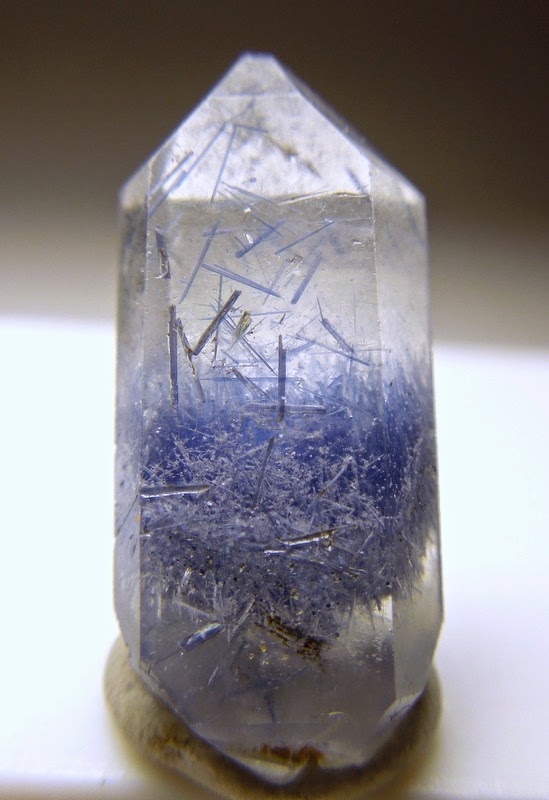
Quartz with Petroleum Inclusions


This is one of my favorite materials from Pakistan. I have been buying small quantities of it for 3 years. I know there was a production around 2002 and the pieces were not really big.  Most were around 10 mm in size.
The material was gone really fast and around 2008 small quantities started to show up again. Then in 2011,  I ran into a small parcel with bigger stones, with pieces ranging from 15 mm to one huge 36mm crystal. It was the largest piece that I had ever seen or heard of.  I had never paid so much money for Quartz.
I was lucky again to get a few larger pieces in Tucson this month.
So I thought I would share with you a little bit about these special crystals.
They are very transparent, "water clear" crystals.  The faces are smooth and very lustrous without pronounced striations, making the perfect canvas for the inclusions with no interference inside or outside the crystal.
The most visible inclusion is the petroleum trapped in the cavities
and negative crystals. It is usually bright yellow with some that are slightly brown.
Some of them have methane bubbles within the petroleum. Some move, some are stationary. Although not very visible, a lot of the times, there is a small amount of water along the edges of the cavities.
Many of these crystals also host black and brown Asphaltite, the group name for bituminous hydrocarbons. The Asphaltite can be found inside the Quartz with no fluid association and sometimes
it can be seen inside the cavities along the petroleum. In a few  rare cases, the Asphaltite moves freely within the cavity.
I noticed that in cold days, the bubble moves slower than usual but if you just hold it for a couple minutes, it warms up and starts moving faster again.
This alone makes it a fascinating material. But on top of all that,  it fluoresces bright blue under long wave UV. Now that is insanely cool!
Here is a little photo gallery and a video at the end. Click on the photos to see them larger.
                             Large cavity with moving bubble:
                            Two paralell cavities with moving bubbles:
                     
                             Negative crystal cavity:
                             Fluorescence:
                             Methane Bubble and Asphaltite:

                            And a short video:

Monday, October 24, 2011

Chicken Pie

This is a very traditional Brazilian take on chicken pie. In Brazil, we call it "empadão de frango".
It is not complicated, but as with pies in general, it is a little time consuming. I had the whole Sunday, that I promised myself I wouldn't work. Nothing like spending a cold Sunday baking. I also baked a cake, (recipe later) I was never a big baker. I like to eyeball things and that just doesn't work with baking, or chemistry experiments.
So here is the Recipe:
Crust:
3 cups of flour
1 stick of butter, (about 100g)
1/2 cup of canola oil
1 egg yolk
1/2 teaspoon of baking powder
1/2 cup milk 
1 teaspoon of salt
Mix the ingredients by hand, (it is not a sticky dough.)
Cover a springform pan, bottom and sides and poke with a fork.


Filling:
3 cups of chicken breast (cooked and shredded)
1 small onion, chopped finely.
3 cloves of garlic, minced or through a garlic press.
2 cups of crushed tomatos. (I buy them in a can, no salt added, no basil, just tomatoes)
1 cup of chopped green olives
1 cup of chopped palm hearts. (Some palm hearts can be tough, so when you are chopping, if it feels fibrous, toss it. I usually discard the outer layer and use the soft centers.) Or you can substitute for corn kernels.
1 cup of catupiry cheese. Ok, this is the tricky part. I buy it at a Brazilian market, here in LA. It looks like this: 


I think Philadelphia cream cheese may work. I never tried it, but I imagine it would take a little longer to melt.

Sauté the onions until translucent. 
Add the garlic and the chicken and give it a nice stir for a minute or so. Add the tomatoes, olives, palm hearts (or corn)  and let it simmer for 5 minutes.
Add the cheese and blend it well. The mixture should not be runny, but a nice cream. If you think it's too thick, you can add a drop of milk.


 Fill the pie crust and top it however you like it. I didn't have a lot of tools nor patience. So mine was a basic top with a little heart (I need to get some more cookie cutters). I also had some left overs so I made a little one. Brush it with egg wash, and bake it for about 30 minutes depending on the thickness of the crust. It should look golden brown. Let it cool for 15 minutes and serve it with a nice salad. 


Tuesday, July 12, 2011

Oxtail with Polenta


I had never cooked oxtail before. I had it a couple times this year in different restaurants and had been thinking about giving it a try.
First, get over your fear of pressure cookers and get one. I just got an electric one from Cuisinart  and I am in love with it. It is very safe and the lid will not open if there is still pressure inside. Second, find a good butcher. I found the coolest butcher shop in LA!  Coolest because they are two girls, selling locally produced, humane and sustainably raised meats. If you are in LA, you should check Lindy & Grundy!
So here is how the story goes:
3 pounds of oxtail.
1 medium onion, chopped.
5 garlic cloves, minced.
3 tomatoes, chopped.
half a bottle of red wine.
3 clovers, 1 or 2 cinnamon sticks.
1 branch of rosemary, 1 large sprig of thyme,
1 bay leaf,
olive oil, salt and pepper to taste
2 bunches of watercress, chopped.

                                          Don't forget to wear your matching flip flops


Trim the fat of the oxtail, season it with salt and pepper and brown it on a heavy bottom pan.
In the pressure cooker, saute the onions, and add the garlic, the tomatoes, stir a little and add the herbs and spices. Add the oxtail, and the red wine and sprinkle a little more salt. Lock the lid in place and set on high pressure for 30 minutes. After the 30 minutes, release the pressure valve and when the steam is out, open the lid, add half the watercress (1 bunch),  give it a couple stirs, check the salt and close the lid again and set another 30 minutes on high pressure. (Don't forget to engage the valve back to pressure)
Do the same procedure to open the lid again. Remove the oxtail from the pan and transfer to a plate.


Pour all the sauce in a bowl and put it in the fridge for an hour or so, (I like to do that so the fat in the sauce hardens and I am able to remove all the fat on the surface of the bowl. I do that to make a leaner dish, if you like richer, you can skip that step.) Remove the bones and fatty parts from the oxtails, pull all the meat and set aside.


Transfer to a pan along with the lean sauce and adjust the salt. Add 1/2 a bunch  of watercress at the very end and serve hot over polenta made with chicken stock and milk and finished with a little butter, half a cup of "Lamb Chopper" cheese and the rest of the watercress.

                      Looks great and tastes even better!


Friday, May 27, 2011

Artichoke Risotto


When people ask me what my favorite thing to cook is, I never think twice: Risotto!
This one is so full of flavor, I think it is one of my favorites.
Artichoke can be a little headache to work with but it is not difficult. I usually remove the petals, cut it in four. Remove the hairy chokes with a pairing knife or a melon baller. Keep a bowl of cold water with lemon juice aside and put the clean pieces of artichoke in it so they won't get dark. The stalks are edible, just peel the outer skin.
You are going to make a herb pesto and keep it in the fridge. You can do it hours ahead.
Here we go:

Pesto:
1 medium bunch fresh basil – leaves removed from stems
8 springs fresh Italian parsley – stems removed
1 large garlic clove – skinned and left whole
1 teaspoon finely grated lemon zest (use microplane grater)
5 tablespoons extra virgin olive oil
1/2 teaspoon sea salt

Blend all the ingredients in a food processor or blender and keep it in a container with some plastic film covering it or a thin layer of olive oil on the surface so it doesn't turn brown.

For the Risotto:

3 large artichokes in large pieces, (slices or cubes) well rinsed to remove all chokes.
4 cups water
1 chicken stock cube or vegetable stock. 
1/4 cup extra virgin olive oil
1 medium onion – chopped       
2 large garlic cloves – finely chopped or pressed
1 cup dry white wine
1 cup of Arborio rice
1/2 teaspoon sea salt
freshly ground black pepper to taste
1 tablespoon of butter
1/2 cup freshly grated Reggiano parmesan

Boil the artichoke pieces in 4 cups of water for 6 minutes. Drain the artichokes and keep them aside, saving the water they were cooked. Heat a wide heavy-bottomed pan over high heat. Add the olive oil and onion, stir well and sauté for 3 minutes until translucent. Add the garlic, give it a couple stirs, and add the rice, mixing it well to coat with the the olive oil. Add the white wine and stir well until the rice absorbs the wine.
Add the stock cube to the water you cooked the artichokes, mix well, and start to ladle the broth into the rice, little by little, without stopping to stir, after 8 minutes add the artichokes, and keep stirring and adding broth. after 15 minutes start trying the rice to see if it;s all dente or to your desired texture. ( you may need a little extra broth or even just water) When it is cooked to your liking, (it should take 17 to 20 minutes) add the butter and parmesan, give it a vigorous stir and turn of the heat. Adjust the salt if necessary.
Stir in the pesto (add half, taste, and then add more to your liking) Serve immediately.